Nada Rawlins – Celebrating Survival and Replenishment
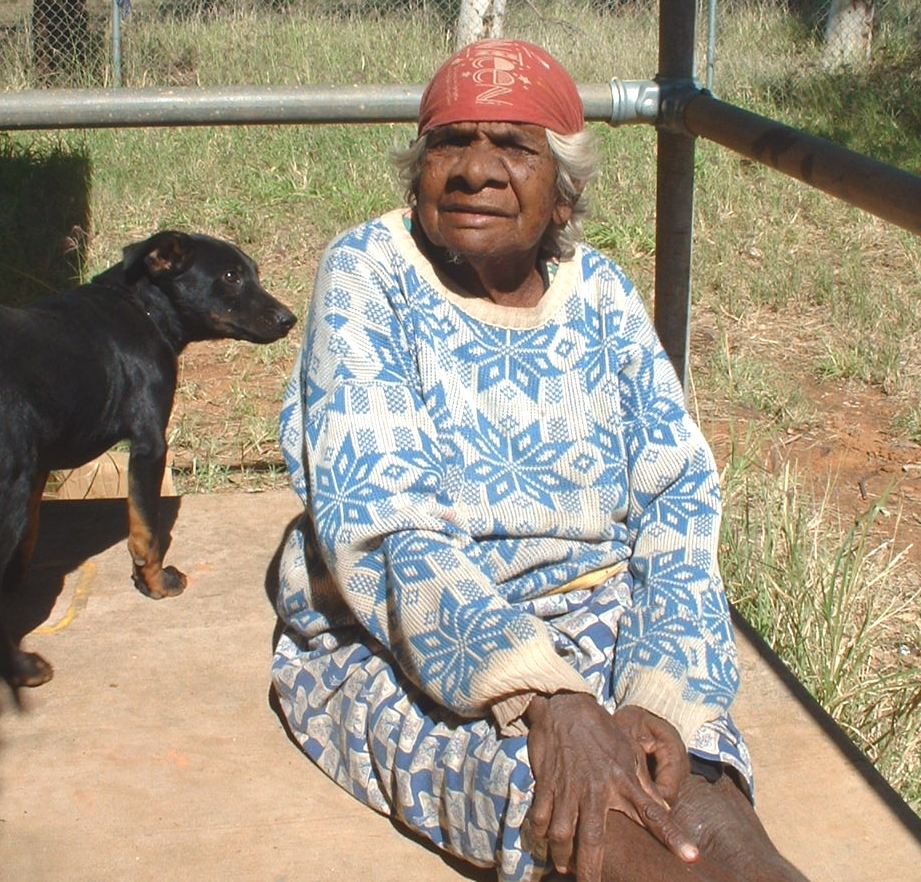
In this article, curator David Wroth reflects on an exhibition of work from the artist Nada Rawlins. David met Nada in the early 2000's when she painted in the small community of Wangkatjungka between Fitzroy Crossing and Halls Creek in Western Australia. David retells the story of how her family embarked on an epic walk north out of the Great Sandy Desert. He reflects on the significance of the fresh water sources that were known to her family. These waterholes are celebrated in an exhibition of vivid playful works that hold very precious memories and stories from this past generation.
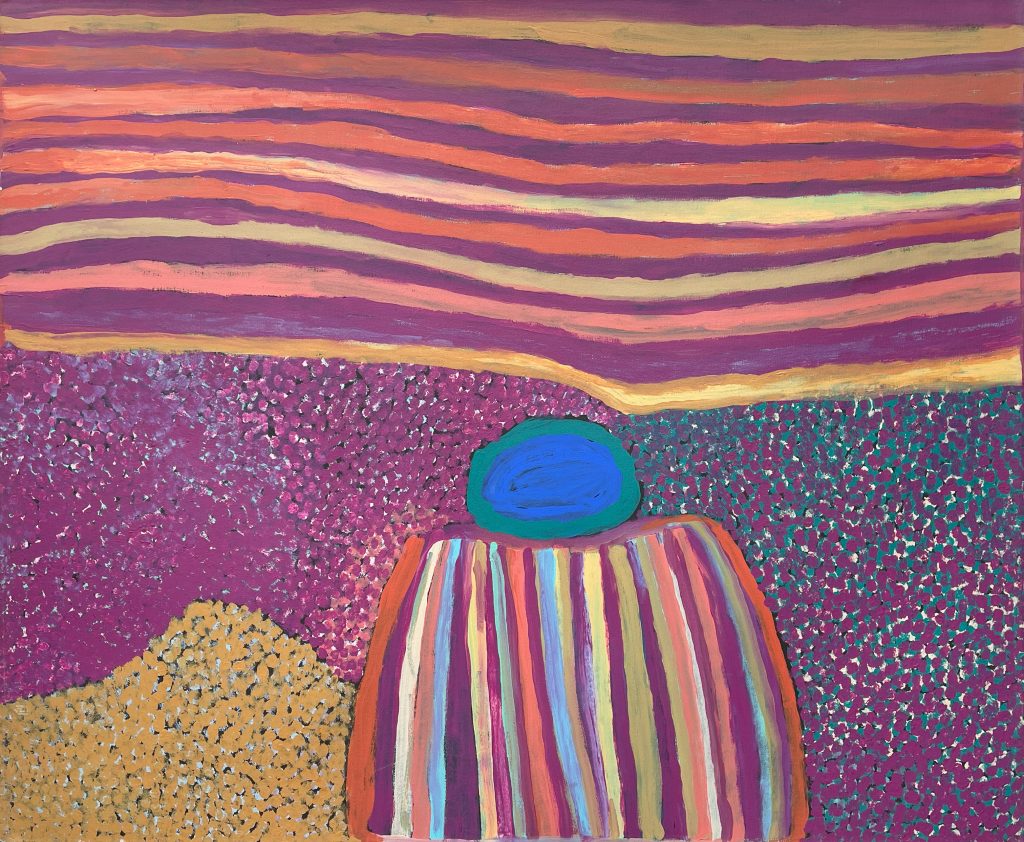
Feature Image: Nada Rawlins | Waterholes
A 70-Year-Old Master of Desert Colours
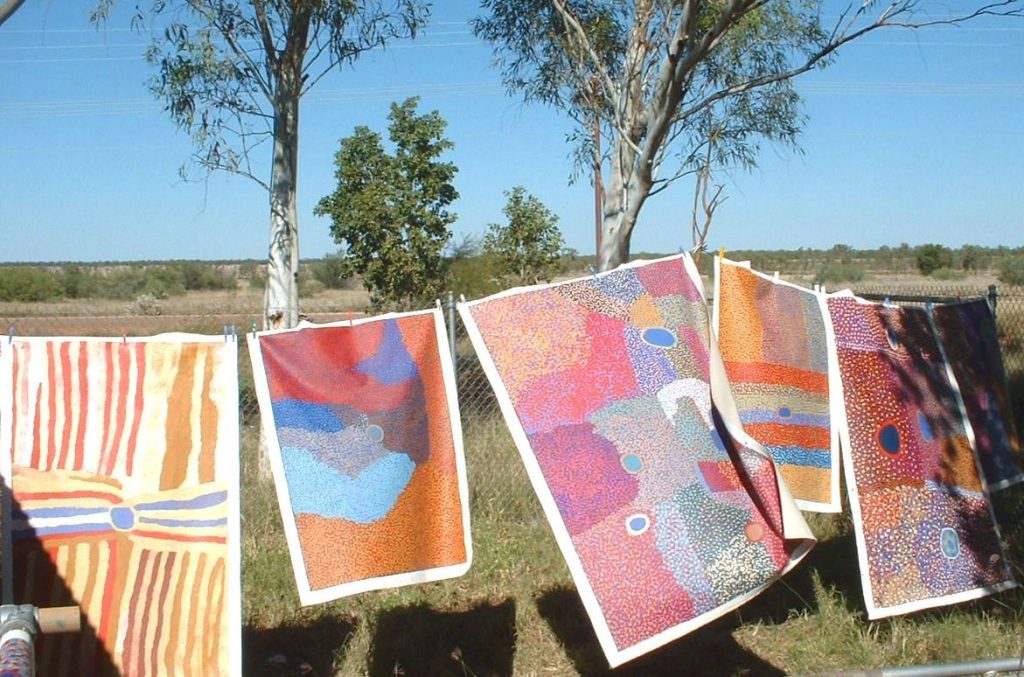
We have exhibited Nada's work through the 2000's. As a 70-year-old painter, she created these luscious, generous paintings. Her colour schemes are saturated and intense. They feel like the desert. Their simplicity and playfulness show Nada's connection through memory and traditional knowledge of her country.
The Epic Walk: An 800km Journey North
Young Nada and her family walked out of their traditional lands in the 1950s. They walked all the way up to Billiluna, a remote Aboriginal community and station located in the south-east Kimberley region of Western Australia, approximately 150 km south of Halls Creek.
The family then followed the river system down to Christmas Creek, where they eventually settled. Maps suggest a 400 kms walk from Percival Lakes to Billiluna, and not much less than that to walk to Christmas Creek. It was an enormous walking journey. The stories that Nada carried with her are the stories of her family and their long existence on that traditional country in the Great Sandy Desert.
Painting Memory: Recording Sacred Waterholes
Nada began painting in the 1990s. She was remembering all those places, and her stories record the names of the water holes that were connected together in her country. There are creation stories connected to these places, and she would have learnt these stories from her family. Those names and the creation stories that go with them are the descriptions of place and how these places came to be. Nada would add little details like whether it was rocky country or whether there were good food resources around those waterholes.
Hidden Wells: Freshwater Beneath the Salt Lakes
One of the extraordinary things she told us was about the Percival Lakes, an enormous chain of salt lakes out in the Great Sandy Desert. She said the main freshwater holes that their family relied on were actually inside the lakes. They had fresh water wells that went down below the level of the salt water lake, and this underground water was their fresh water source. Nada named the five water holes that were the main holdings of her family, including Kiriwirri (the name of this exhibition). It was also the name of the region where Nada was born. She records that this was the place where her father died.
When the Desert Failed: The Great Exodus
The stories Nada is telling are about the travelling history of her clan as they walked all those hundreds of kilometres up north into the Kimberley region. This was a time when there were droughts in the desert. The desert people were leaving in numbers for more sustainable places. The Canning Stock Route had been a conduit that connected the desert to the cattle station country of the Kimberley.
A Generation That Knew the Desert
Nada travelled up to Billiluna and up towards Balgo, and then followed the river courses back in a southwesterly direction back into the area where she finally settled. It's a huge exodus story. These were the people who carried the stories and the knowledge of these waterholes. They are the last generation to live in those parts of the desert. It is primarily uninhabited now. This means those freshwater holes are not being dug out and cleared of drifting sand. Her story of the Percival Lakes is about the extraordinary connection between these people and their very remote desert home.
Layered Paint, Layered Memory
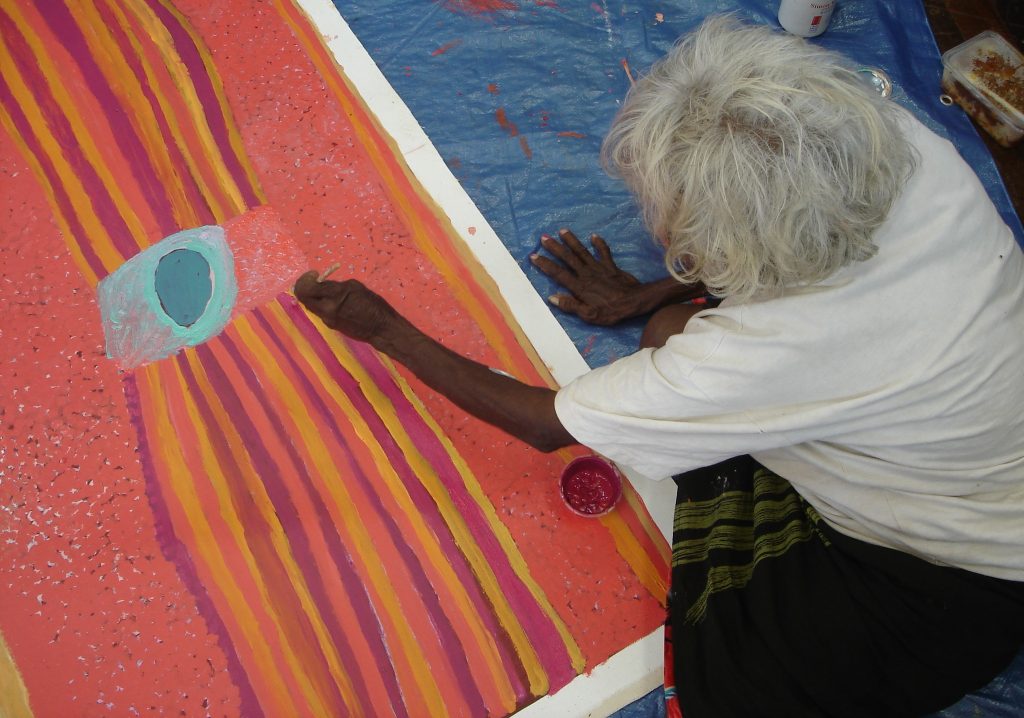
It might surprise you to see how Nada's paintings are so very playful and pared back. They are quite simplified and vividly colourful. She tended to work with many layers of quite fluid paint. She would paint over and over until she had the textures and results she wanted. The paintings carry those intense reds and oranges and pinks of the desert country, and the contrasting important waterhole locations.
A Room Full of Country and History
I first met Nada in the early 2000s. This opportunity to hang a room full of her paintings now is such an intense experience. It's little bits of her country, her history, and the memories she has about it. She's a distinctive artist and the room is full of colour and intensity. These were significant locations, this fresh water in the desert. They represent survival and replenishment. You can feel that energy and have a wonderful connection with the desert country. We tend to think of deserts as being harsh and arid. But some of these paintings are bursting with life. There's the growth of trees, and these were not arid places to a traditional person who has lived there. It is full of life, it's full of possibility.
What Dies When the Elders Pass
I'm not sure whether it's nostalgia that Nada can create through these wonderful paintings, but it is a sense of how important this country was. Yet now it's largely an unpopulated part of Australia. So what the artist is telling us is once this part of Australia was everything to her family and extended family. They cared for it, it was wonderful country. This is one person's connection to those memories and all that traditional knowledge that belongs to that generation. Nada died in 2019, as she and other elders pass, much of this knowledge goes with them. Really, there's no one else who can use it in the same way as that generation of people could.
Wangkatjungka
Nada painted all these paintings in the small community of Wangkatjungka, located between Fitzroy Crossing and Halls Creek. It's a little Aboriginal settlement adjacent to Christmas Creek Station. Nada and the other elders at Wangkatjungka painted and exhibited as a collaborative group. Japingka's experience was spending time in the early 2000s with that artist group and exhibiting works in our gallery and elsewhere. We wanted to convey a very special message: the Wangkatjungka artists have a unique story and a distinctive way of sharing it through their art.
Nada: A Generous Spirit and Storyteller
Nada was a really generous person. She had a wonderful disposition and was really happy. She enjoyed participating in activities that were happening. She told us the story that she was very sick as a child. At the end of that epic family trek, she had to be hospitalised for a while. I didn't meet her until she was in her late sixties or seventies. She was a most generous and welcoming person. A wonderful personality who laughed a lot. It is very moving to stand here surrounded by her work and her precious stories.
View
Nada Rawlins - Artist Profile and Paintings
Kirriwirri - Nada Rawlins: Exhibition at Japingka Gallery, 2025
The Wangkatjungka Remote School Mentors Project