
Ian Rictor – Desert to Canvas
The Last Family Out of the Desert
Until 1986, Ian Rictor and his family walked their ancestral homelands in the Great Victoria Desert. That same year, they encountered white people for the first time.
Forty years on, nine of Ian's paintings of Spinifex Country hang at Japingka Gallery at a major new exibition of works by Spinifex Artists.

When the Spinifex Artists exhibition opens at Japingka Gallery on 20 November, nine of its 34 paintings will be by Ian Rictor. Every one of them shows country he walked as a young man, when his family lived in the Great Victoria Desert as their ancestors had for thousands of years.
That life continued until 1986. Forty years later, Ian is one of the senior painters of the Spinifex Arts Project. Collaborative paintings he has worked on are held by the British Museum and the National Gallery of Australia. In 2026 he had a solo exhibition in Darwin and was a finalist in the National Aboriginal and Torres Strait Islander Art Awards.
A family in the desert
Ian was born at Artulin, close to Tuwan, in the heart of Spinifex Country. He is a custodian and traditional owner of Tuwan.
During the 1950s the British nuclear tests at Maralinga pushed most Spinifex people off their homelands and into missions far to the west. The Rictor family stayed. Mr and Mrs Rictor and their sons Noli, Ian and Mick kept walking from water source to food source across the sandhills, living entirely from the country.
In 1986 relatives located the family and brought them in to join their Spinifex kin. Professor John Carty, co-editor of Sun & Shadow: Art of the Spinifex People, writes that the family had lived alone in the desert for 25 years, and that the Rictor children encountered white people for the first time that year. They are the last known Aboriginal people to have lived traditionally in the Great Victoria Desert.
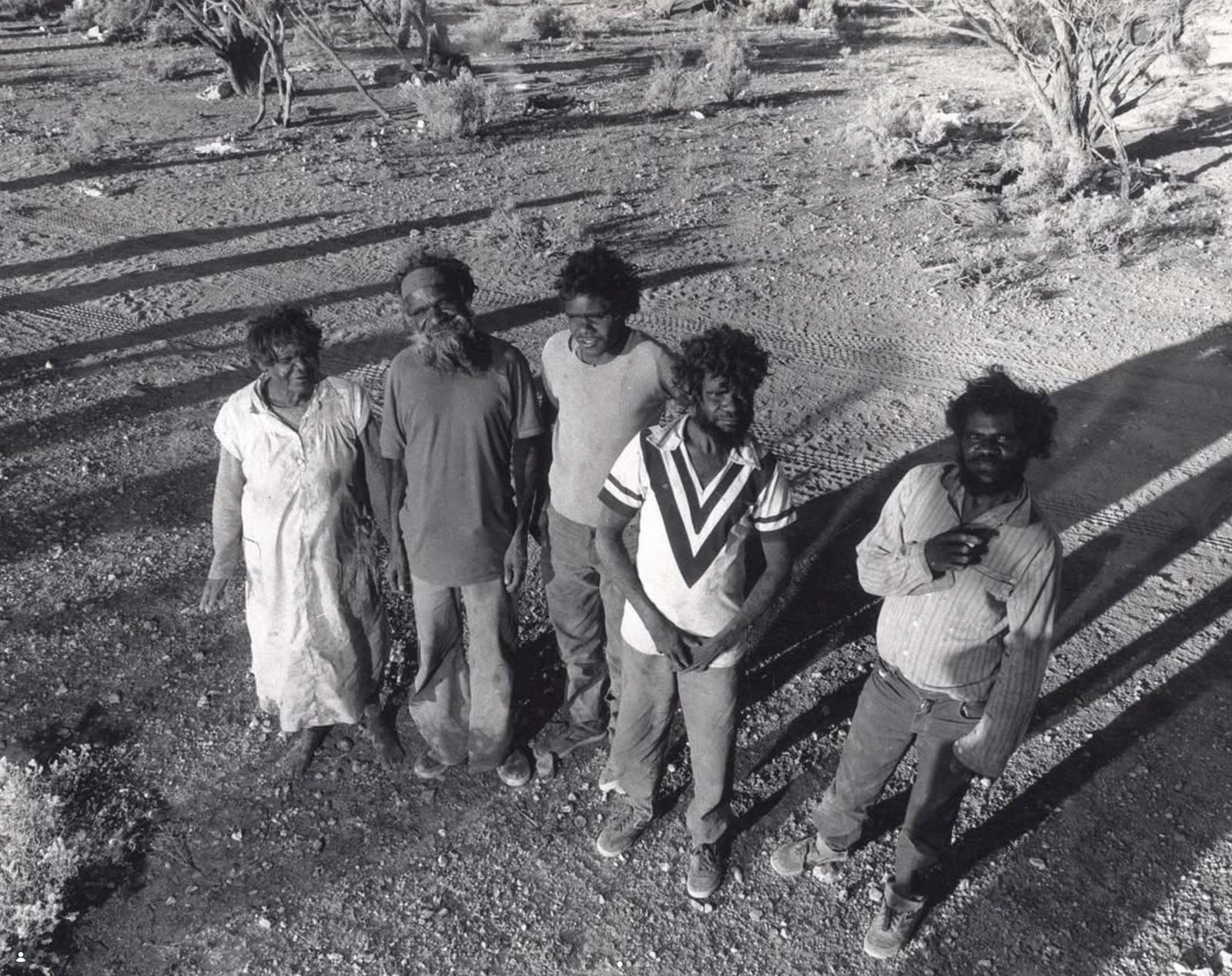
Japingka director David Wroth has known Ian's work for many years. "Ian Rictor is widely recognised among the people from Tjuntjuntjara as the last person to come out of the desert," David says. "He tends to be comfortable on his own country. He has travelled to a few cities, but that was enough of an experience for him."
Painting Tuwan
The Spinifex Arts Project began in 1997, when the Spinifex people started painting their country to support their native title claim. Ian was keen to join from the start. In 2000 the Spinifex people became the first group in Western Australia to have their native title recognised, and the paintings made for the claim were later gifted to the Western Australian Museum.
Ian has painted his birthplace and the country around it ever since. Tuwan is the home of the Nyii Nyii Tjukurpa, the Zebra Finch Creation Line. It is a men's story that follows a group of Zebra Finch Men as they travel south to stop the rising seas. Much of the story is restricted, so only its outline can be shared.
One of his paintings in this exhibition, Kapi Piti Tjuta: Ngayuku Ngura, shows Tuwan together with the sites of Wyara, Kututjara and Artulin. Wyara belongs to the Thorny Devil Woman story and Artulin to the story of the Mala, the reddish-brown hare-wallaby. The Spinifex Arts Project describes these sites as constants throughout Ian's work.
"He creates the most beautiful depictions of waterhole and sandhill country," David says. Bold lines set out the structure of each painting, and fine dot work fills the spaces between them.
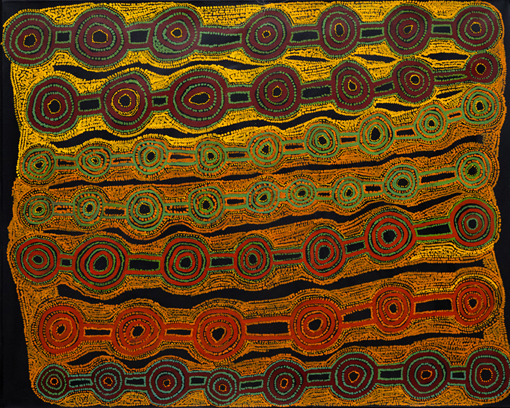
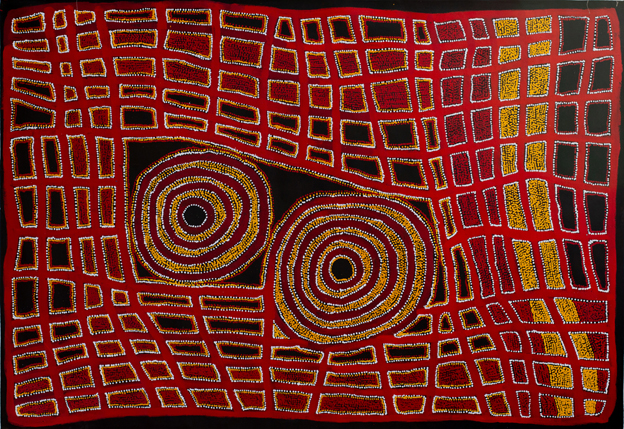

Ian lives at Tjuntjuntjara with his extended family, and is a skilled hunter, bush mechanic and craftsman. His wife, Kathleen (Kanta) Donnegan, is also a Spinifex painter, and the two have made paintings together that Japingka has exhibited. His brother Noli Rictor paints as well.
24 years with Japingka
Japingka first exhibited works by the Spinifex artists in 2002, in an exhibition called Putitja Nguru: Art of the Spinifex People. Ian's work was in it. More than 40 artists travelled from the desert to Fremantle for the opening, and the television cameras followed them into the gallery.
There have been about a dozen Spinifex exhibitions at Japingka since then, and Ian Rictor has had paintings in most of them. Japingka director Ian Plunkett says the artists' approach has never changed.
"They have a real integrity to what they paint. They only paint country. They never paint for a market. It's really truth telling. It's saying, 'Look, this is my country. I know it and this is what it's like. And only I can paint this because I know it intimately.'"
Ian Plunkett, Japingka Gallery
The Spinifex artists paint only for exhibitions, and they work with a small handful of galleries. Japingka has been one of them since the beginning.
"We've been exhibiting their work now for 24 years," Ian Plunkett says. "I look forward to every exhibition because I know it's going to be something really special. When the paintings arrived there must have been about 10 parcels, and it was better than Christmas."
This year's exhibition also includes senior artists Lennard Walker and Ngalpingka Simms, a Men's Collaborative painting, and work by five younger Spinifex painters.
View the exhibition: Spinifex Artists 2026
Japingka Gallery, Fremantle. 20 November 2026 to 20 January 2027.